TAC Solutions: Strategic communication for law enforcement and first responders.
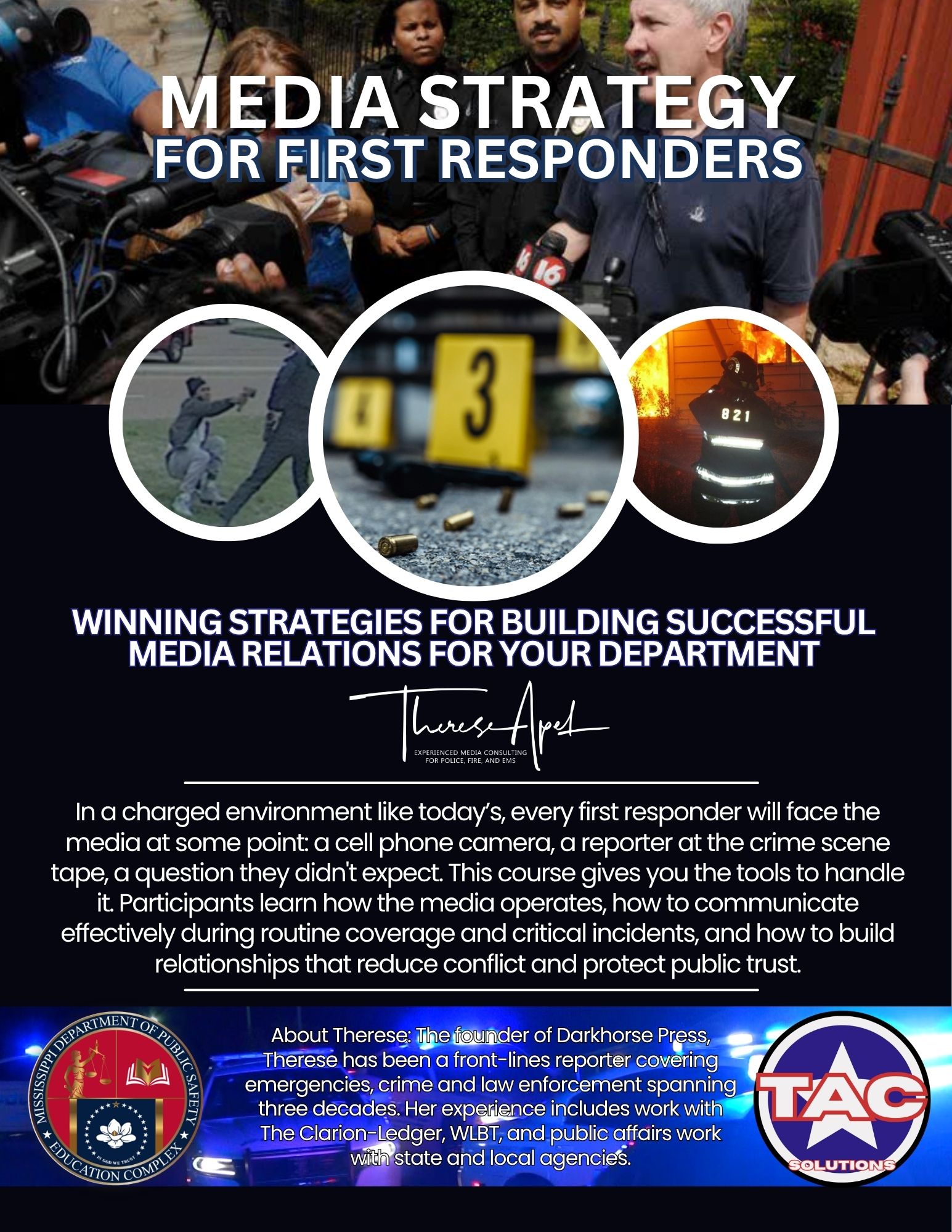
In a charged environment like today’s, every first responder will face the media at some point: a cell phone camera, a reporter at the crime scene tape, a question they didn't expect. Get the tools to handle it with our Media Strategy class and learn how the media operates, how to communicate effectively during routine coverage and critical incidents, and how to build relationships that reduce conflict and protect public trust.
If you need advice on how to handle something you're already in or something that's coming, we provide crisis communication proven to help get your message across at prices that are reasonable to first-responding agencies.
We can also help you with the everyday things: The press releases, the social media, the talking points for your press conferences.
More than three decades in the media business and almost 20 years covering only crime, catastrophe, cops, and other first responders, as well as elite training through federal and regional courses: That's given us the arsenal we need to help you when you're facing down the cameras. Give us a call.
Classes and Consulting
The most well-rounded media strategy planning you didn't know you needed, but you do.
When a critical incident hits, the cameras don't wait, and what you say in those first minutes can shape public trust for years. This class prepares officers, first responders, and agency spokespeople to face the media with confidence instead of dread.
Taught by Therese Apel, Mississippi's most well-known crime journalist with nearly 30 years covering crime, courts, and law enforcement, this training pulls back the curtain on how newsrooms actually work: how to build the trust, what reporters are looking for, how a story gets framed, and how to deliver a clear, accurate message that protects both your agency and your community.
Your instructor also holds FEMA Advanced Public Information Officer (PIO) certification and full ICS credentials (100–800), and is a certified PIO instructor approved by the Mississippi Board on Law Enforcement Officers' Standards and Training, combining real newsroom experience with the emergency-management framework first responders operate in every day.
You'll learn how to prepare for interviews, handle tough questions, stay on message under pressure, and turn a chaotic scene into a controlled, professional exchange. Whether you're a seasoned PIO or stepping in front of a microphone for the first time, you'll walk away ready to own your message when it matters most.
When a major incident unfolds, it isn't just the spokesperson in front of the cameras, it's the whole chain of command making fast decisions about what gets said, who says it, and when. Brass Class brings the training directly to your agency, preparing your command staff and department to speak with one clear, unified voice under pressure.
Delivered on-site over one, two, or three days, this program is built around your agency's real-world needs. Rather than a one-size-fits-all lecture, it works through the situations your people actually face, from critical incidents, use-of-force scrutiny, ongoing investigations, and the media firestorms that can follow. Your team learns how newsrooms operate, how to coordinate messaging across ranks, how to support your PIO instead of undercutting them, and how to protect both the agency's credibility and the public's trust when the stakes are highest.
Brass Class pairs real newsroom insight with emergency-management structure.
Whether you need a focused one-day intensive or a comprehensive three-day program, Brass Class leaves your entire command ready to handle the media as a team before the next crisis tests them.
When a crisis hits your agency, the clock starts immediately, and every decision about what to say and what not to say carries the weight of your department and its reputation.
That's where I come in. I work alongside your leadership in real time to help you navigate high-stakes situations, shape a clear and accurate message, and protect your credibility when public trust is on the line.
Whether you're facing a critical incident, intense media scrutiny, or a story that's spiraling faster than you can respond, I help you cut through the chaos and take control of your narrative. My methods are proven in real-world situations, not theory, and I'm glad to provide examples and references so you can see exactly how this work holds up when it matters most.
From the first phone call through the last follow-up question, you'll have a steady, experienced partner focused on getting you through the crisis with your reputation and community relationships intact.
For public safety agencies, social media is where your community turns first for information, especially when something goes wrong. Done well, it builds trust, shares critical updates fast, and shows the human side of the people who serve. Done poorly, or left silent, it leaves a vacuum that rumors and misinformation rush to fill.
I help police departments, fire departments, emergency management agencies, and EMS providers take control of their online presence. That means keeping your community informed day to day, telling the stories that build goodwill before a crisis ever hits, and being ready to push out fast, accurate information the moment it counts. I understand both how newsrooms and the public read these posts and the operational realities your agency works within — so your messaging stays professional, accurate, and true to your mission.
Whether you need someone to manage your accounts start to finish, build a strategy your team can run themselves, or step in during high-pressure moments, I'll help you turn social media into one of your agency's most valuable tools for public trust.